

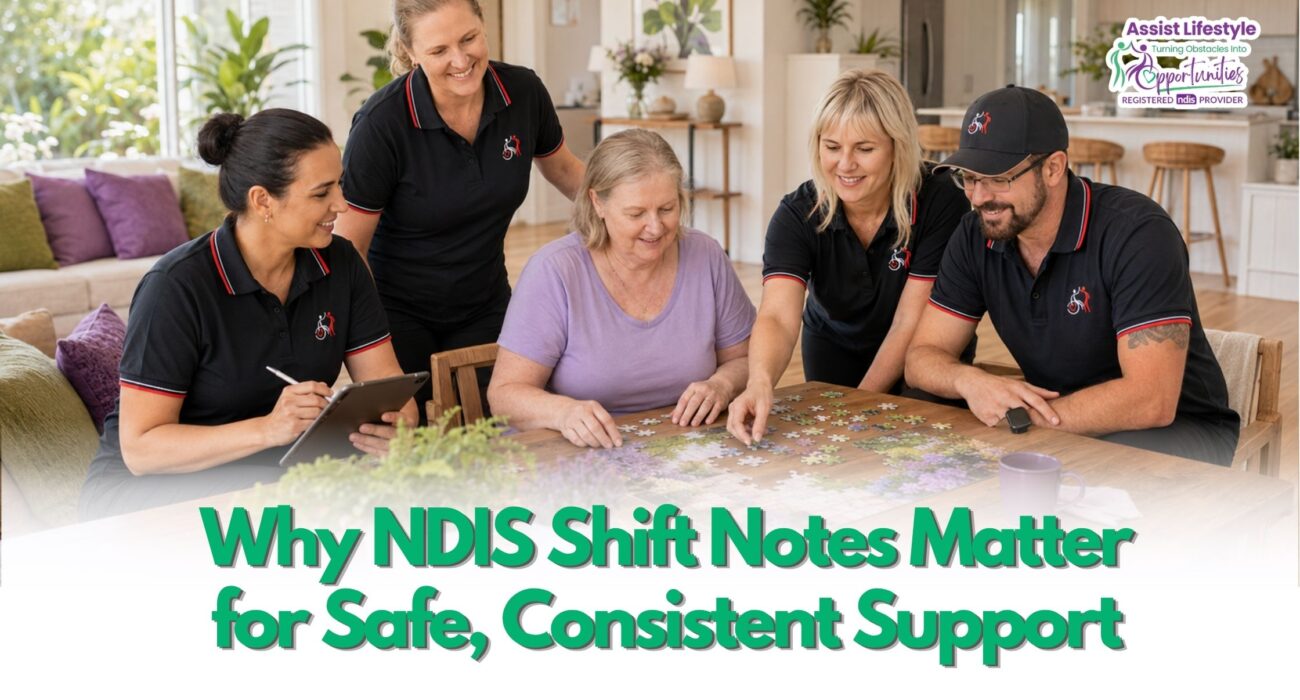
When you receive disability support, you may notice your support worker taking a few minutes to complete notes during or at the end of your shift.
These notes are more than administration. Clear and accurate shift notes help create a reliable record of the support you received, assist communication between workers, identify important changes or risks, and help demonstrate progress towards your goals.
At Assist Lifestyle, we believe documentation should always be respectful, factual, relevant and focused on the support being provided.
What are NDIS shift notes?
Shift notes are records completed by support workers about the support delivered during a particular shift.
Depending on the support provided, a shift note may include:
- the support and assistance provided
- activities completed during the shift
- relevant progress towards your NDIS goals
- prompting, supervision or assistance you required
- changes in your support needs or routine
- relevant achievements or outcomes
- risks, health or safety concerns that require follow-up
- incidents or important information that needs to be communicated to the support team.
Good documentation helps provide a clearer picture of what support was provided and why it was needed.
This is consistent with the NDIS Practice Standards, which include requirements for registered providers to manage participant information so that it is accurate, current and confidential.
How shift notes support consistent care
Many NDIS participants receive support from more than one worker.
Clear shift notes can help relevant members of the support team understand what has happened during previous shifts, including changes in routines, support needs, risks or strategies that have worked well.
For example, appropriate documentation may help workers understand:
- what level of prompting or assistance is usually required
- communication preferences
- changes that may affect the next shift
- strategies that support independence
- emerging risks that may need monitoring or follow-up
- progress towards agreed goals.
This can support better communication and greater consistency across the participant’s support team.
How can shift notes contribute to NDIS evidence?
Shift notes themselves do not guarantee NDIS funding, and routine shift notes are not automatically reviewed by the NDIA.
However, good documentation can help providers prepare accurate progress reports and other information about the supports delivered, outcomes achieved and ongoing support needs.
The NDIA explains in its guide to report writing for providers that provider reports can outline the supports delivered and outcomes achieved and, where relevant, provide evidence about the need for future supports.
The NDIA also advises that information used for a plan reassessment may include reports from treating professionals, therapists or support workers showing how supports are helping a participant work towards their goals.
For this reason, detailed and accurate support records can be valuable when a provider needs to prepare a report about your progress, support needs or outcomes.
Looking beyond the activity itself
A shift note should describe the disability-related support provided, rather than only listing the activity.
For example, instead of recording only:
“Went for coffee.”
A useful note may explain that the participant was supported with:
- planning the outing and making choices
- organising transport
- managing anxiety or unfamiliar environments
- communicating with other people
- managing money or completing a purchase
- navigating the community safely
- practising social or independent living skills.
The purpose is not to make ordinary activities sound more complicated than they are. It is to accurately record the support that was actually required and provided.
Respecting your privacy and dignity
Your privacy matters.
The NDIS Code of Conduct requires NDIS providers and workers to respect the privacy of people with disability.
The NDIS Practice Standards relating to privacy and dignity also require registered providers to have processes that respect and protect participant privacy and dignity.
At Assist Lifestyle, our expectation is that shift notes are:
- factual and objective
- respectful
- relevant to the support provided
- focused on the participant’s needs, goals, safety and outcomes
- free from unnecessary or judgemental personal comments.
Information should only be recorded where there is a legitimate reason connected with the participant’s support, safety, service delivery or provider responsibilities.
Why Assist Lifestyle requires shift notes
Assist Lifestyle requires our support workers to complete appropriate documentation as part of our service delivery and quality systems.
As a registered NDIS provider, we are expected to maintain systems that ensure participant information is recorded accurately and in a timely way, kept confidential and used appropriately by relevant workers.
For this reason, we cannot simply stop keeping required support records.
However, this does not mean participants lose choice or control over how their personal information is handled.
We encourage participants to speak with us if they have questions or concerns about what is being documented, why information is being recorded or how their information is managed.
Can I access my shift notes?
You can contact Assist Lifestyle if you would like to request access to personal information we hold about you.
Australian privacy law provides a general right to request access to personal information held about you, although some exceptions may apply. You can learn more through the Office of the Australian Information Commissioner.
Assist Lifestyle will manage requests for access to participant records in line with applicable privacy requirements and our information-management processes.
Good documentation supports good support
Quality shift notes are not about recording every detail of a person’s life.
They are about maintaining an accurate and respectful record of the support that matters.
When documentation is done well, it can help:
- support continuity between workers
- identify changes in support needs
- monitor progress towards goals
- recognise achievements
- improve safety and risk management
- provide information for progress reports
- demonstrate what disability-related support has actually been delivered.
Most importantly, documentation should always respect the person behind the record.
At Assist Lifestyle, we are committed to providing safe, respectful and person-centred NDIS supports while protecting each participant’s privacy, dignity, choice and control.
If you have questions about your support, documentation or how we manage your information, our team is happy to help.
Contact Assist Lifestyle
Assist Lifestyle – Registered NDIS Provider
Sunshine Coast | Nambour | Noosa | Gympie