

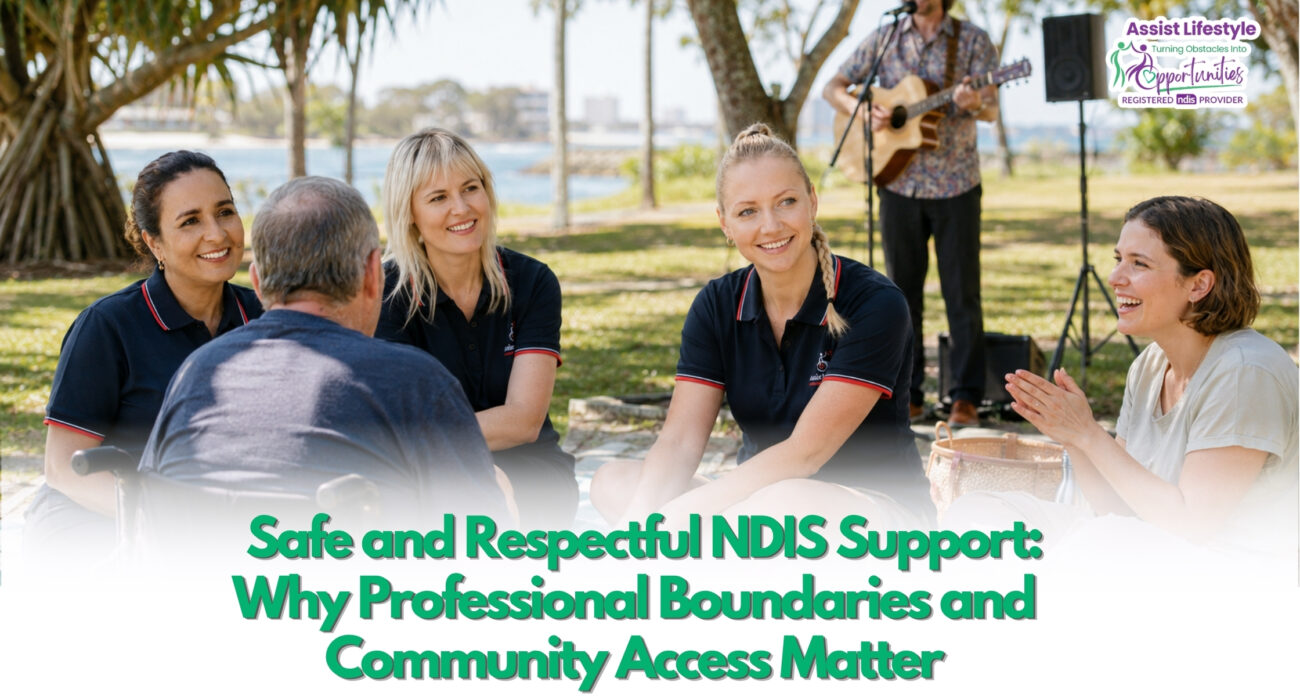
When choosing a National Disability Insurance Scheme (NDIS) provider, participants, families and carers want to feel confident that supports will be safe, respectful and focused on the participant’s goals.
At Assist Lifestyle, we believe quality support is about more than completing daily tasks. It is about building trust, respecting choice and control, and providing support in a way that protects each person’s dignity, privacy, safety and wellbeing.
Two important parts of safe, high-quality disability support are clear professional boundaries and safe community access. These help protect participants, families, support workers and the wider community.
What Are Professional Boundaries in NDIS Support?
Professional boundaries are the ethical, legal and practical limits that help keep the relationship between a support worker and an NDIS participant safe, respectful and appropriate.
Because support workers may assist participants in their homes, during daily routines or out in the community, relationships can naturally feel close. However, the relationship must remain professional and focused on the participant’s needs, goals, rights and wellbeing.
The NDIS Code of Conduct requires NDIS providers and workers to act with respect, deliver supports safely and competently, respect privacy, act with integrity, and take reasonable steps to prevent abuse, neglect, exploitation and harm.
Key Examples of Maintaining Professional Boundaries
Professional boundaries may include:
Communicating Respectfully
Using appropriate language, maintaining a calm tone and avoiding over-sharing personal, financial or relationship problems.
Protecting Private Information
Handling participant information carefully and in line with the Australian Privacy Principles, confidentiality requirements and organisational policies.
Following the Participant’s Support Plan
Delivering support in line with the participant’s goals, service agreement, support plan, risk guidance and relevant allied health recommendations.
Keeping the Relationship Appropriate
Avoiding personal, financial, romantic or family-like relationships that could create confusion, pressure or conflict of interest.
Avoiding Gifts, Loans or Financial Arrangements
Support workers should not borrow money, lend money, accept expensive gifts, buy items from participants or involve participants in personal financial matters.
Not Taking Advantage of Trust
Participants must never be pressured, influenced, coerced or exploited.
Escalating Concerns Correctly
Any concerns about safety, wellbeing, boundaries or potential harm should be reported through the provider’s internal processes and, where required, relevant external pathways.
Clear boundaries help create safe, predictable support. They protect participants from harm, help workers maintain professional practice, and give families and support networks greater confidence in the quality of care being provided.
Why Boundaries Do Not Mean Being Distant
A common misconception is that professional boundaries make support feel cold or disconnected. This is not the case.
Good support can still be warm, kind, friendly and encouraging. Boundaries simply provide a safe framework so the participant knows what to expect and the worker understands their role.
For participants, this can build trust and consistency. For families, carers and Support Coordinators, it helps show that supports are being delivered ethically and respectfully.
The NDIS Practice Standards also highlight the importance of participant rights, privacy, dignity, informed choice, independence and freedom from abuse, neglect, exploitation and discrimination.
Safe Community Access and Social Participation
Community access is an important part of many NDIS supports. Depending on a participant’s plan, goals and funding, support may assist with building independence, confidence, daily living skills and community connection.
The NDIS includes support categories such as Assistance with Social and Community Participation and Increased Social and Community Participation. Not every participant will have funding for every support category, so supports should always align with the participant’s approved plan and goals.
Safe NDIS community access may include support with:
- Grocery shopping and personal errands
- Attending appointments
- Visiting friends or family
- Joining local clubs, groups or community activities
- Exercise, outdoor activities and wellbeing routines
- Attending community events on the Sunshine Coast
- Learning to use public transport
- Exploring hobbies, interests and creative activities
- Building confidence in everyday community settings
Community access should always be person-centred. This means support should be guided by the participant’s goals, preferences, communication needs, sensory needs, mobility needs, risks and support plan.
Balancing Choice, Control and Safety
The NDIS is built around participant choice and control. Participants have the right to make decisions about their own lives, including decisions that may involve reasonable risk.
This is often called dignity of risk.
However, dignity of risk does not mean workers can ignore safety, legal obligations or their duty of care. Participants should be supported to make informed choices, including understanding the benefits and risks of different options.
If a community access situation becomes unsafe, unpredictable or concerning, workers must respond calmly and follow the participant’s support plan, risk guidance and organisational procedures.
Responding to Unsafe or Illegal Activities
Support workers must not participate in, encourage or enable unsafe, abusive or illegal activity.
If a situation becomes unsafe during support, workers should:
Prioritise Immediate Safety
Move themselves and the participant away from danger where it is safe to do so.
Use Calm Communication and De-Escalation Strategies
Follow any relevant behaviour support strategies or communication guidance.
Contact a Supervisor or Manager
Seek guidance as soon as possible and follow organisational escalation procedures.
Document the Incident
Record what occurred clearly, factually and respectfully.
Call Emergency Services if Required
Call 000 if there is immediate danger, serious risk of harm, a medical emergency or urgent safety concern.
Under Queensland work health and safety laws, businesses and workers have duties to protect the health and safety of workers and others affected by work activities.
Where an incident occurs in connection with NDIS supports, it may also need to be managed under the provider’s incident management system. Some incidents must be reported to the NDIS Quality and Safeguards Commission.
How Assist Lifestyle Supports Safe Practice
At Assist Lifestyle, we are committed to delivering NDIS supports that are respectful, person-centred and safe.
Our team supports safe practice by focusing on:
Understanding Each Participant’s Goals
We take time to understand what each participant wants to work towards.
Following Support Plans and Risk Guidance
We align support with participant goals, service agreements, support plans and relevant professional recommendations.
Encouraging Independence
We support participants to build skills and confidence wherever possible, rather than taking over tasks unnecessarily.
Respecting Privacy and Dignity
We handle participant information with care and respect each person’s right to privacy.
Maintaining Professional Boundaries
We promote safe, appropriate and respectful relationships between participants and workers.
Supporting Safe Community Access
We consider each participant’s needs, preferences and risks before and during community-based support.
Communicating Openly
We work with participants, families, carers, Support Coordinators and allied health professionals where appropriate and with consent.
Responding to Concerns
We take feedback, risks and incidents seriously and use them to improve the way supports are delivered.
No two participants are the same. That is why our support is tailored to each person’s goals, routines, preferences and support needs.
Looking for Quality NDIS Support on the Sunshine Coast?
If you or someone you care for is looking for safe, respectful and personalised NDIS support on the Sunshine Coast, Assist Lifestyle is here to help.
We provide a range of NDIS supports across the Sunshine Coast, Nambour, Noosa, Gympie and surrounding areas, including:
- NDIS Community Access and Social Participation
- Daily Living and Personal Care Support
- Support Coordination
- Psychosocial Recovery Coaching
- Domestic Assistance and Household Tasks
- Supported Independent Living and Home and Living Support
- Individualised Living Options
- Transport and appointment support
If you are looking for an NDIS provider that balances genuine connection with safe, professional support, our friendly team would be happy to chat.
Contact Assist Lifestyle today to discuss your support needs, ask questions or start a referral.